Tuesday, February 28, 2012

Creamy Golden Oatmeal

Here's how you can use some of that leftover barley I was talking about (leftover from Beef and Barley Stuffed Peppers). I think you're allowed to be in love with your own recipes and I'm in love with this one.

This recipe for creamy oatmeal will make your breakfast a lot more interesting. It incorporates barley for some extra texture, golden raisins and crunchy almonds. Who said oatmeal had to be dull and boring?


This recipe serves one, but can be easily made for more! It's quick and easy enough for any weekday morning, but also fit to be savored on the weekend.

Creamy Golden Oatmeal

Ingredients
  • 1/4 cup dry oats, quick-cooking
  • 1/2 cup water
  • 1/2 cup barley, cooked (leftover)
  • 2 tablespoons golden raisins
  • 1/2 to 1 cup skim milk, depending on desired consistency
  • Sprinkle of cinnamon
  • 2 tablespoons almond, chopped

Instructions
Place oats and water in microwave-safe bowl. Microwave for 1 minute. Remove from microwave and add barley, raisins and milk. Stir. Microwave again for 1 minute. Remove, stir, then top with cinnamon and almonds.

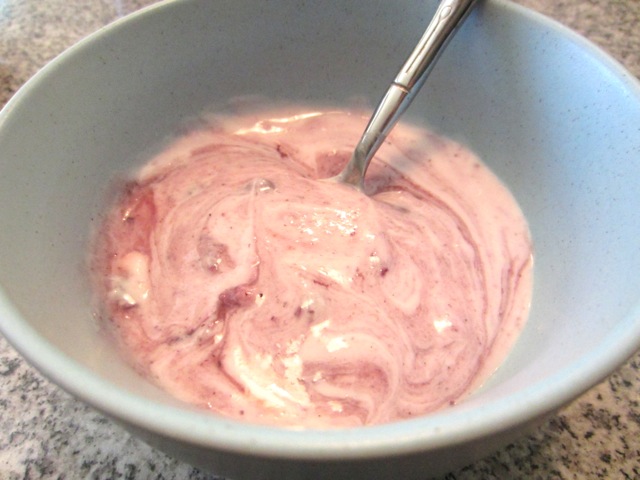
Creamy deliciousness. Cooking the raisins makes them plump and soft. The cinnamon adds a touch of sweetness. To me, this is a warm, comforting breakfast at its finest. Good food definitely tastes good!

Sunday, February 26, 2012

Product Review: Stonyfield Organic Yogurt


I often get the opportunity to try products and review them on my blog. Stonyfield recently sent me a coupon to try a complimentary sample of one of their organic yogurts. I love yogurt, so I was grateful! Here's what I thought about the low fat blueberry variety.

The yogurt was uniquely creamy, with a rich texture, even though it was low-fat. I'm picky about yogurt--the consistency can really be a turnoff. But Stonyfield's brand was smooth without a lot of extra stirring. It also had lots of berry flavor. I only wish it had contained more whole blueberries! Of course, I can always add some to it, but the label claim, "fruit on the bottom," makes me think there will be some chunks of fruit to mix around, and there were few.

The yogurt was really filling. I ate it for lunch yesterday with only an open-faced sandwich. Ordinarily, I would be hungry within a couple hours. But it lasted me all afternoon! It would also make an excellent, lasting, super-healthy snack choice.

I really liked the nutrient profile compared to other comparable brands. Even though the Stonyfield yogurt is not made with artificial sweeteners, it only has 21g of carbohydrate--similar to many yogurts that are made with artificial sweeteners. I'm not against sweeteners, I just don't like the aftertaste of many of them, so I especially avoid them in yogurts.

There are only 120 calories per 6-ounce container, 1.5g total fat and 1g saturated fat. Again, lower than many other comparable low-fat brands. Typically I purchase non-fat yogurt because the saturated fat is just too high in most low-fat yogurts, but that's not the case here.

A few other nutritional components of note:

  • The ingredient list is fairly short and all the ingredients are comprehensible; that's great because I like to know what I'm eating.
  • The 6-ounce container provides 25% of the daily value (DV) for calcium and 15% DV of vitamin D.
  • It's gluten-free, as yogurt should be. Again, no hidden ingredients that don't need to be there.
  • There are six varieties of live, active cultures. A great reason to enjoy yogurt--gut health.
  • Stonyfield's "Organic Promise" is that their yogurt comes from cows raised without the use of antibiotics, synthetic growth hormones and persistent pesticides.

I also can't help but mention that the cow with glasses on the front is adorable!

I have to admit, that for the most part, I buy plain, non-fat yogurt. I just prefer it. But I really liked the Stonyfield Organic brand. When I'm looking for something a little different, I would buy it again, but I would definitely have to add more fruit. For those looking for a product made with organic ingredients, this is a great choice.

Stonyfield yogurts are available at most grocers. Find out more about them and their products here.

Saturday, February 25, 2012

Stuffed Peppers...And More Ways to Use Barley

My wonderful co-op, Community Helpings, has been delivering tons of green peppers lately! I love them, but I've gotten more than I can slice and eat for lunch before they spoil. Solution? Yummy stuffed peppers. If this is not one of your favorites, don't turn your nose up just yet--this recipe just might surprise you. Stuffed peppers are a versatile, tasty and filling dish that can also be super nutritious. And they're a cinch to make! The following recipe will make leftovers if you're a smaller family--which is great, right? Freeze the extra, eat it for lunch or make a second meal out of it a few days later. Nothing beats having the work done. I make stuffed peppers differently every time and this time I really had a craving for barley.

Talk about comfort food!

Beef and Barley Stuffed Peppers

Ingredients:
  • 2 cups barley, cooked
  • 1 1/2 cups brown rice, cooked
  • 6 green peppers, sliced in half lengthwise, seeds and stem removed (slice the pepper, then cup the seeds in your hand and pull, the whole mess will come out and it's faster!)
  • 1 pound lean ground beef
  • 1/2 yellow onion, chopped
  • 10 mushrooms, chopped
  • 2 cans low-sodium diced tomatoes
  • 1/2 teaspoon Italian seasoning mix (or basil and oregano)
  • 1/2 teaspoon garlic powder
  • Fresh ground black pepper

Instructions:
Prepare barley and rice according to package instructions. (You will probably have to use separate pots). Meanwhile, sauté onions in a medium to large-sized pot until they begin to brown. Add ground beef, season and stir. When beef is browned, scoop out any grease, then add mushrooms and tomatoes. Stir it all together. Lay peppers down in a large baking dish. When barley and rice are cooked, scoop out appropriate measurements and stir into meat mixture (you might have extra, depending on how much you prepared). Stuff the peppers--they should be heaping! It's optional to add a sprinkling of cheese across the top--I had a little extra Gruyere, so I used that this time.

Cover with foil and bake at 350 degrees for 45 minutes. Remove cover and continue baking for 10-15 minutes, or until cheese begins to brown. Enjoy!

A few extra comments: Whenever I cook barley, I always make extra. It takes so long to cook that I don't have time to do it often! In the winter, I love to add it to my oatmeal in the morning (P.S. Watch for a recipe coming up soon). You could always add it to soup or enjoy it as a side dish too. Making a big batch is a great way to save yourself some time during the week and it's easy to freeze for convenience.

I also said that stuffed peppers are versatile. What's that mean? You can stuff them a variety of ways and they're always a bit different! My husband's request this time was Mexican style. He suggested stuffing the peppers with yellow rice, black beans, the onion, ground beef and tomato mixture, and topping them with cheddar cheese. Good one, honey. Next time for sure.

Try the recipe and let me know what you think!

You'll always find my recipes included in my Pre-Planned Menus, available for purchase on my website.

Thursday, February 23, 2012

Do the Products in Your Pantry Make the Grade? Try Fooducate.


I did some research this morning. In my fridge and pantry. With my iPhone.

There are a ton of food and nutrition apps out there and I have to admit that I have not tried them all. One of my colleagues recently told me about Fooducate. Since I love giving my clients more resources, and it was free, I thought I’d evaluate it. 

It was actually pretty fun. If I didn’t have to get to work on time, I could’ve spent all morning scanning every food in my house! It's very simple to use: You search for a food in the Fooducate database by scanning the barcode with your phone and the app gives the product a grade. Just like in school, a product will get an A, B, C, etc. Along with the grade, you get information about why the product was rated the way it was. Processing? Whole grains? Additives? The app will point out the benefits and flaws. 


I liked how comprehensive the database was. It had many typical brand name products as well as products made by Trader Joes. The only items I couldn’t locate were Schnucks store brand (St. Louis chain grocer), but I could search by hand for similar products (and you have the option of entering the product information to send to the creators to have it added to the database). It will also store the products you’ve searched for in a list, so you don’t have to search all over again if you want to re-read the details.

I do have, however, a pretty big problem with the grading system. You might think this would be a turn-off completely, but keep reading. Here are some of the products I scanned, which as a dietitian, I would deem very healthy. In other words, I would have given them all As. But here’s what Fooducate gave them:


Plain, quick-cooking oatmeal: B+ (what?!)
Skim milk: A- (why not an A+?)
Natural, unsalted peanut butter: A- 
Whole wheat spaghetti: A-
Apples: A- or B+ (unbelievable)
Lettuce: A- or B+ (again; unbelievable)

It was really hard to get an A. Too hard. Granted, everything we eat will not be given an A grade; and that’s okay. But based on my assessment of the healthy foods above, I think this is majorly disappointing and frustrating. If I find it frustrating (when I know the right answer) how will consumers feel? Probably like it’s too hard to find anything that’s good for you. I already hear that concern often enough.

That said, the “extra” information that Fooducate gives you about the product’s grade is very helpful. I found tips like:

“This product is minimally processed.”
“Multigrain is NOT necessarily whole grain.”
“Salty! Has over 20% of the daily max.”

I thought these tips were terrific guidance to help the user learn about selecting healthy foods and to steer them to other, healthier products, if needed.

All in all, this is a neat resource. I think the “tips” are enough to warrant downloading the app (the free version, at least). But–consumers still should have some foundational diet knowledge before using it! Although we should all know that fruits and vegetables are healthy for us, I’m met with misconceptions every day. Many people think they shouldn’t eat certain fruits and/or vegetables for one reason or another (ie. sugar content, pesticides) and the grading system could definitely cause more confusion. By the way, any fruit or vegetable is good for you, especially if it’s fresh.

If you choose to download the app, great. It’s a cool learning tool. But meet with your Dietitian first!


Photo credit: Supermarket by Ambro

Tuesday, February 21, 2012

New 'Great For You' Logo is a Great Idea


Picture this: You’re standing in the cereal aisle at the grocery store and you want to make a healthy choice. But you’re faced with claims like, “Half your daily fiber needs,” “Lower in sugar” and even the cereals that look like they’re made with candy seem to scream out, “Made with whole grains.” What’s the best choice? If you’ve been in this situation before, you’re not alone.
As obesity and various nutrition-related health crises face many Americans today, health and food organizations have been looking for innovative ways to simplify the consumer’s decisions about food. This year, new initiatives will be rolled out in the grocery store, which can sometimes feel like a maze. 
We currently use the Nutrition Facts Label to asses the health of products in the grocery store. But I hear from many of my clients that it's very confusing. I spend a lot of time teaching clients to read labels so they can learn to make health-conscious decisions about the food they're buying. Organizations like the Institute of Medicine (IOM) and the Grocery Manufacturer’s Association (GMA) have proposed front-of-package labeling systems in an attempt to simplify the label and highlight important nutritional aspects. Some systems are already in place, and quite honestly, it doesn't seem to have helped.
The IOM and GMA have proposed new labeling systems that would rate packaged foods on a points scale: more points means it's a better choice. The rating, along with calorie information and nutrients to discourage, would appear on the front of packaged foods. Wal-Mart just brought their version to the table too--and if you ask me, they’re the bread-winner.
Wal-Mart recently unveiled the “Great For You” logo which will appear on its own brand products that meet certain nutritional criteria (or branded products that meet the standards). These criteria are based on the 2010 Dietary Guidelines for Americans and the latest science. There’s a two-step process used to determine if a product will be able to boast the new logo. First, the scheme considers "foods to encourage," as listed in the Dietary Guidelines: fruits, vegetables, whole grains, low-fat dairy, nuts and seeds and lean meats. If a product meets this first standard, then the amounts of total, trans and saturated fats, sodium and added sugars ("nutrients to discourage") are considered. This system also considers non-packaged foods, like produce, which of course should get the seal of approval.
Will the public like it? I hope so. We have to get away from labeling foods as “good” and “bad.” Consuming a "bad" food often leads to feelings of guilt and failure, even if it isn't eaten very often. The “Great For You” approach helps us focus on the positive by highlighting some of the foods that are the very best to eat. And, this seems like a simple solution that can help consumers quickly pick out the healthiest items at the store. As I always say: healthy eating shouldn't be that difficult.
So, you’re back on the cereal aisle. Select a box that’s marked with the “Great For You” logo. Done.
Get ready. It’s coming this spring.
To read more about the new logo, nutrition criteria or download a list of products bearing the seal, click here.


Photo credit: Ambro